

“McNeal Hall dedication features dream-come-true gallery for University’s Design Department”
—University of Minnesota Alumni News, October 1976
50 YEARS OF DESIGN
A BRIEF HISTORY OF THE GOLDSTEIN
Before “The Goldstein” was a museum, it was a gallery. In recognition of the dedication of the Goldstein Gallery in October 1976, and the many individuals who launched this institution, the Goldstein Museum of Design celebrates its 50th anniversary throughout this academic year 2026-27.
Origins
The idea for a gallery on the St. Paul campus honoring pioneering University of Minnesota faculty Harriet and Vetta Goldstein originated, unsurprisingly, with their former students. (“They gave me the world and the eyes to see it with,” one remembered, reflecting the adoration shared by generations of Home Ec alumnae.) Natalja Hurley Klingel, class of 1939, suggested the notion in 1973 to former classmate Edna Engvall Kroll, who brought it straight to Keith McFarland, dean of Home Economics.
McFarland knew directly and respected deeply the legacy of the Goldstein sisters, who had brought international prestige to Home Ec through their design-based Related Art program (from 1913) and influential textbook Art in Everyday Life (Macmillan, four editions 1925-1954). Planning was underway for the major construction project that would produce McNeal Hall in its present form, making new gallery space possible in the central addition joining the 1914 Home Economics building to the north and the 1899 Horticulture building to the south. The vision was championed by Department of Design head Gertrude Esteros, who had studied under the Goldsteins and led Related Art after they left the University in 1949. “As soon as there was a breath about a new building,” she recalled, “we decided that a gallery was important enough to our department to give it top priority.”
“Dream come true”
Committee meetings were held, proposals were drafted, letters were circulated, and by May 1, 1974, the Goldstein Gallery was approved by the Board of Regents. Within a few weeks, McFarland presented both sisters with the news in Los Angeles, where they had moved from Minnesota. They were overwhelmed by the honor.
At McNeal Hall, work by architects The Hodne/Stageberg Partners (with interior designers William Bowen, Gary Wheeler, and Lee Meyer) progressed. In June 1976, an open house and “pre-dedication exhibition" was organized featuring Representative Work by Students in the Design Department for attendees of the American Home Economics Association annual convention in Minneapolis.
The dedication ceremony for the new McNeal Hall and the Goldstein Gallery took place on October 14, 1976. Harriet had died on November 1, 1974; Vetta, still devastated by the loss but encouraged by friends, returned to St. Paul for the day-long event. (She had traveled widely, including a 1925-26 voyage around the world with Harriet, but this was her first trip by plane.) On view in the gallery was the first official exhibition Selections from the Design Department Permanent Collection: A Dedication Exhibition Honoring Harriet and Vetta Goldstein. McNeal reportedly “bulged” with attendees, and following formal presentations, 86-year-old Vetta received former students one by one, late into the night, in the gallery-adjacent space now known as the Goldstein Lounge. Days later, a gala organized by the integral Minneapolis-St. Paul Fashion Group in support of the collection presented a Bonnie Cashin retrospective exhibition, with the renowned designer participating as a featured guest.
Collective efforts
Described in its early years as “a showcase for designed objects,” “an unusual laboratory,” “a unique extension of the classroom,” and “an irreplaceable teaching and exhibition resource,” the Goldstein Gallery was planned from the start “for use by students, faculty, and the community at large.” It succeeded thanks to the work and support of faculty, graduate students, alums, and passionate community members.
In 1978, the consequential Friends of the Goldstein was founded by journalist Margot Siegel (later honored for her 30 years of Alumni Service) to provide financial support for operating expenses as well as volunteers and publicity. The initial group included Timothy Blade, Ethelyn Bros, Margaret Carlson, Sylvia Druy, Joanne Eicher, Marie Eller, Polly Grindering, Gloria Hogan, Eugene Larkin, Vandora Linck, Harriet Martin, Keith McFarland, Margaret Morris, Martha Saul, Ruth Shipley, and Myra Zabel. A charter membership program was started and exceeded 500 supporters in its first weeks.
The gallery was administered in this period by the College of Home Economics’ Department of Design (later Design, Housing, and Apparel) and led through its first decade by department heads: Gertrude Esteros, followed by Joanne Eicher. Faculty expanded their work to serve in curatorial roles, beginning with Suman Shenoi and Timothy Blade. Alongside the gallery’s exhibition and teaching program, the permanent collection grew. Decorative arts and textiles used in Harriet and Vetta’s teaching were joined by important foundational collections in areas of enduring strength: historic costume, developed under professor emerita (and former student of the Goldsteins) Helen Ludwig; and designer fashion (1930s-60s) donated by the Fashion Group. This group also began funding for graduate assistantships, which continue as meaningful scholarship and professional training opportunities. In 1986, the first (and, to date, only) Goldstein Gallery Collections catalogue was published for the 10th anniversary. Faculty curators Marilyn DeLong (costume), Anna Mary Creekmore (textiles), and Timothy Blade (decorative arts) provided in-depth essays on these areas of the collection, then about 8,000 objects.
Extending a legacy
Since the early 2000s, the Goldstein has been known as the Goldstein Museum of Design (GMD), with the Goldstein Gallery remaining the primary exhibition space, free and open to the public. Today, GMD is part of the College of Design, and a front door to research and resources at the University of Minnesota—a role shared across the system by the Weisman Art Museum, Northrop, Minnesota Landscape Arboretum, Bell Museum, CBS Conservatory, Raptor Center, Tweed Museum of Art, and Glensheen Mansion. Beyond the University, GMD affiliations include the St. Paul Art Collective, Minnesota Arts & Culture Coalition, Minnesota Citizens for the Arts, AAMG (Association of Academic Museums and Galleries), Costume Society of America, NARM (North American Reciprocal Museum Association), and Museums for All.
Around the legacy venue of the Goldstein Gallery, the museum operates throughout McNeal Hall: specialized staff work year-round in the GMD Research Center and Administrative Office, events are organized in the Goldstein Lounge and main-floor auditorium, educational activities (for K-12, higher ed, and community groups) are conducted in classrooms, and collections are maintained in secure storage spaces. Thanks to the generosity of many donors, the permanent collection today exceeds 36,000 objects—a unique, multidisciplinary resource professionally stewarded and actively used for teaching, research, inspiration, and exhibitions. More than 10,000 are digitized and freely available from anywhere in the world through our online database.
Much has changed since the founding and first chapter of the Goldstein, yet we enter this 50th anniversary year with familiar fundamentals: inspired by the Goldstein sisters, dedicated to design, committed to object-based education, and sustained by community support. Thank you to all those who’ve made our first half-century possible; here’s to the next.
The Goldstein sisters
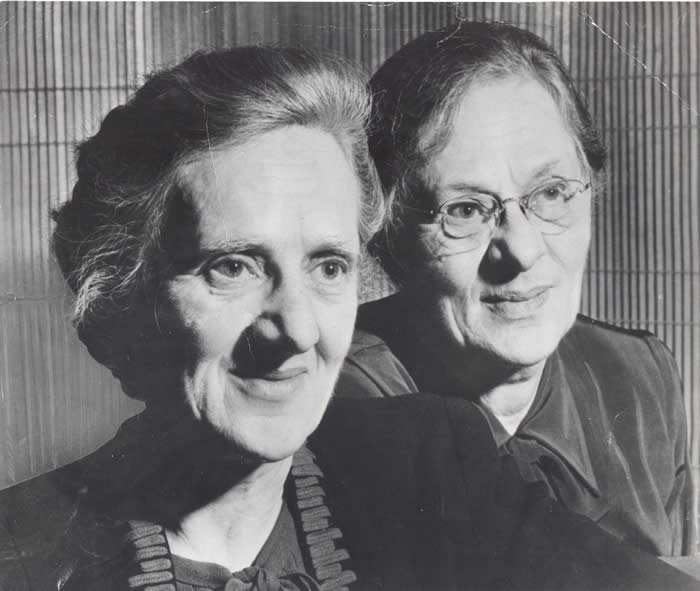
Goldstein Museum of Design is named in honor of two sisters who changed the way Americans value design. Harriet and Vetta Goldstein taught Related Arts in the School of Home Economics at the University of Minnesota from 1910 until 1949, introducing students to the new idea of design harmony and the process of formal analysis to solve design problems.
As instructors, they were thoughtful and encouraging, inspiring students with their passion for supporting good design. Their leadership helped shape design education at the University for decades and set the direction for the College of Design.
The Goldstein sisters studied with pioneering educator Frank Parsons at the New York School of Fine and Applied Arts (now the Parsons School of Design). Parsons had begun a series of groundbreaking programs in fashion, interior design, and graphic design that combined art concepts with industrial design. The Goldstein sisters adapted Parsons’ modern concept of design to their teaching at the University and to their textbook Art in Every day Life (1925, four editions,11 reprintings).
From the late 1920s through the 1950s, Art in Every day Life was used in classes at colleges and universities across the country, helping countless students gain the ability to recognize and create design harmony in their lives. By the 1930s, so many students had learned how to examine design problems that even major industrial designers noticed women demanding better-designed products.
With the expansion of McNeal Hall in 1976, the Goldstein Gallery (now the Goldstein Museum of Design) was dedicated as a tribute to Harriet and Vetta Goldstein. Their leadership helped shape design education across the country and set the direction for the College of Design. Their legacy lives on in the growing collection of design objects and the many exhibitions, past, present, and future.


