
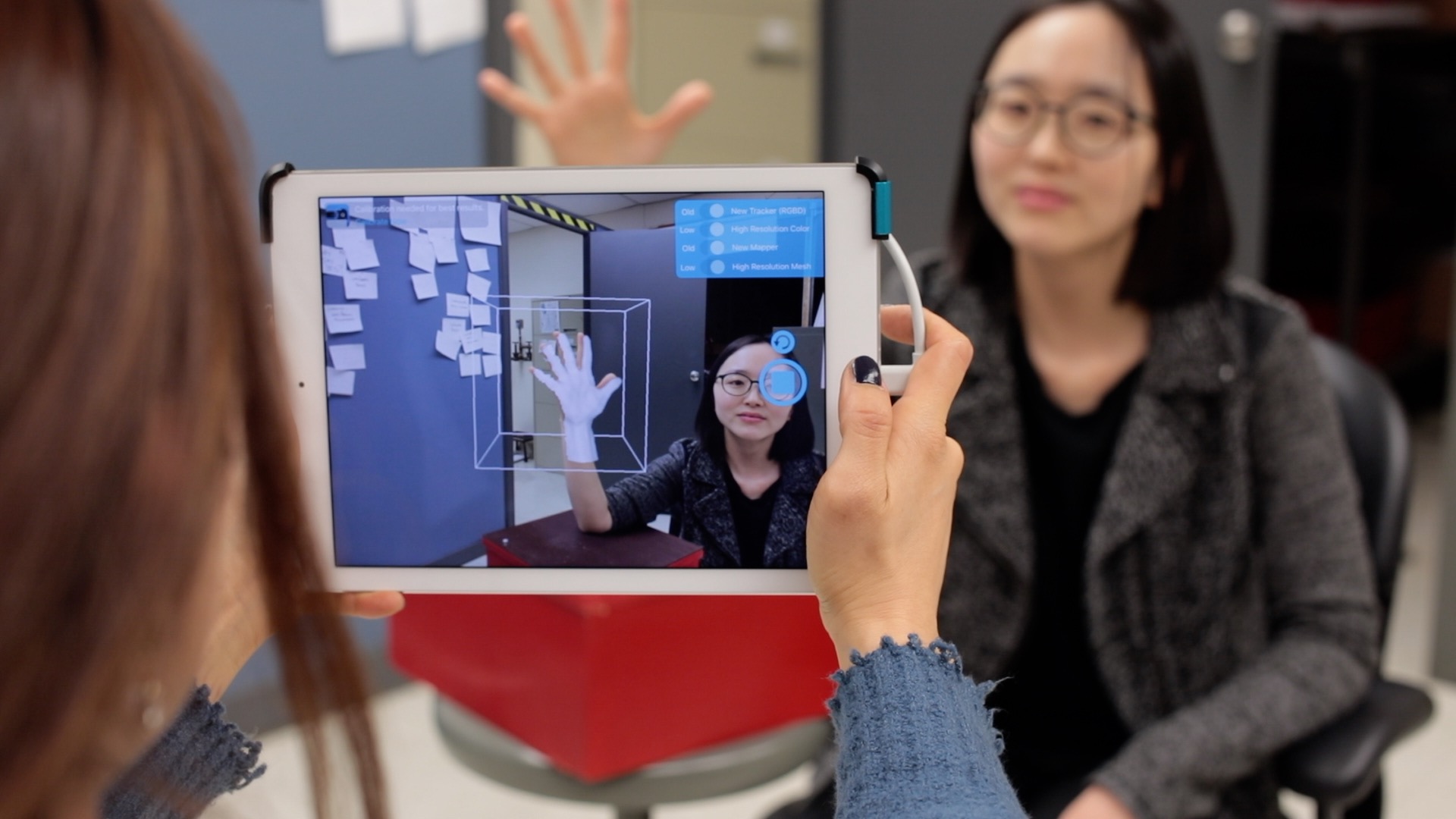
3D Data Integration & Building Database Portfolios
The HDL has built six major 3D anthropometric databases since 2016, scanning 1,500+ participants using handheld, stationary, and dynamic scanning systems. Each database was purpose-built for a specific body-product relationship, with custom landmarking, scanning, measurement, and analysis protocols tailored to that application. The result is a portfolio of design-ready data that connects human body geometry directly to product development spanning hands, heads, faces, feet and full body forms across occupational, pediatric, and clinical populations.
Personalization and Parametric Systems
The HDL develops parametric design frameworks that translate 3D body scan data into adjustable product geometries, enabling devices to be automatically sized and shaped to fit individual users. Rather than relying on population percentiles and fixed-size categories, parametric systems define key anatomical landmarks, proportions, and tolerances that drive design variation in a systematic, reproducible way. This approach bridges the efficiency of mass manufacturing with the precision of custom fabrication, reducing design time while improving fit accuracy.
Data Integration in Action
The typical process for addressing accommodation issues (anthropometric analysis, dimensional adjustment, prototyping, testing, and redesign) often repeats, with slow and indirect integration of anthropometry, as data analysis occurs outside the design process.
The HDL, in collaboration with Synex Medical, demonstrated a faster approach. By integrating 3D hand anthropometric data directly into CAD software, they improved an existing device that originally fit only 15% of the population. The redesigned device achieved 85% population accommodation in a single size, eliminating extensive trial-and-error prototyping. This shows that using data in a new way can actively guide and transform engineering design decisions, offering endless opportunities for data-integration frameworks.
3D Database Portfolio
| DATABASE | PURPOSE & APPLICATIONS | INDUSTRY/SECTOR |
|---|---|---|
| 3D Hand Database | 800+ scans; static and dynamic; shape descriptors (curvature, arc length, webspace depth); air gap analysis; glove and tool fit; female sizing systems; machine learning envelope prediction | Gloves · PPE · Hand tools · Space applications |
| Adult Head / Face Database | 500+ scans; FFR-specific facial anthropometry; respirator fit prediction models; parametric interface design; contact simulation | Respirators · Facial PPE |
| Pediatric Head / Face Database | 150+ scans; pediatric craniofacial shapes (birth–18 yrs, target n=1,000) | CPAP · Nasal / Ear stents · Pediatric NIV |
| Foot & Shoe Database | Interior shoe geometry; prosthetic foot-shoe alignment modeling across heel heights and toe-drop profiles | Prosthetics · Orthotics · Footwear design |
| Firefighter Body Database | Multi-university (8 institutions); full body, hand, and foot scans; sex-specific sizing gaps in gloves, boots, and turnout gear (SizeFF national survey) | Fire PPE · Boots · Gloves · Turnout gear |
| Dynamic Lower Body Database | 4D scanning of waist-hip-thigh region in motion; aging women's functional anthropometry; workwear and automotive applications | Workwear · Automotive PPE · Medical wearables |
| Toyota Manufacturing Database | 336 workers; 1,344 scans at 4 functional positions; hand envelopes, clearances, and space measurements; ergonomic tool and workspace design | Manufacturing · Automotive · Hand-tool design |
Healthcare & Medical Device Design
The HDL is pioneering scalable personalization in medical device design, moving beyond population averages to create devices that fit individual patient geometry, at clinical scale. This work is conducted in close collaboration with the UMN Pediatric Device Innovation Consortium (PDIC), M Health Fairview, and the VA RECOVER laboratory.

Personalized Pediatric NIV Masks
Newborns and children who need non-invasive ventilation often end up with masks that don’t fit their faces and cause injury, or worse. Standard NIV masks are designed for adults and scaled down for newborns and kids. When the NIV mask fails to achieve an adequate seal due to facial size or morphology, clinical teams face an agonizing escalation of care. The HDL is developing a fully personalized NIV mask pipeline for pediatric patients in partnership with medical teams at M Health Fairview, from 3D facial scanning in PICUs and NICUs through automated parametric design to rapid fabrication.
The system generates a customized mask geometry in minutes using key facial parameters, enabling clinical scaling without sacrificing precision. The pipeline integrates craniofacial scanning, parametric modeling, digital contact simulation, and physical validation; surface correspondence analysis identifies compression zones, separation regions, and leakage risk before any prototype is fabricated. Safe and scalable, the system is transferable to a range of on-body medical devices, implantables, and PPE. Funded by the Imagine Fund, Maslowski Charitable Trust, and the UMN Office of Discovery and Translation.
Advancing Prosthetics & Rehabilitation Engineering (VA Partnership)
In collaboration with the Minneapolis VA’s RECOVER Center (Dr. Andrew Hansen), the HDL is developing a parametric prosthetic foot-shoe system enabling individuals with lower-limb amputations to safely wear a wider variety of footwear without requiring a completely new prosthetic system for each shoe. Parametric modeling links heel height, heel-to-toe drop, and full shoe interior geometry to prosthetic alignment behavior, establishing the quantitative fit engineering model of this relationship. The project is funded by the MN Partnership for Biotech Med Genomics Translational Product Development Fund, and its broader framework of open datasets, interoperable shape libraries, and automated design tools is designed to generalize to orthotics, PPE, and other personalized footwear products.


Systems Design & Healthcare
The HDL applies systems thinking to wearable product problems, examining the full organizational, supply chain, and use-context environment to find design opportunities invisible to product-focused approaches. A hospital gown redesign illustrates the power of this method: a systems-of-use analysis revealed that laundry facilities, not clinicians, actually control gown supply, opening entirely new design intervention points that led to improved patient and provider experience.
Personal Protective Equipment & Occupational Safety
The HDL has built one of the most comprehensive research programs in the country on the fit, sizing, and design of personal protective equipment for occupational workers. Across gloves, respirators, and dynamic workwear, the lab's work addresses a common failure: PPE designed without adequate data about the bodies that wear it. The consequences range from reduced performance to genuine safety risk. The HDL builds the data, methods, and frameworks needed to close that gap.
Gloves & Hand Protection

More than 2,000 hand scans from diverse populations have produced the most detailed dataset of hand shape, proportions, and functional geometry available for glove and tool design. A shape descriptor framework using anatomical landmarks enables direct comparison of hand geometry to glove interiors; skeletal overlay visualizations reveal that current glove designs consistently misalign shape and finger proportions relative to the hands they protect. Ill-fitting hand protection is a safety failure rooted in decades of design built on incomplete and unrepresentative data, and the HDL has spent more than a decade building the tools and data needed to fix this.
The HDL's occupational ergonomics work extends this data into workplace applications. Hand clearances, handedness, and functional grip postures vary significantly across worker populations and directly influence tool design, workspace layout, and injury risk. The Toyota Manufacturing study scanned 336 workers across two U.S. facilities in four functional hand positions, producing hand envelopes, clearance dimensions, and ergonomic design recommendations for tools and workspaces, demonstrating how population-specific hand data can drive measurable improvements in occupational safety and efficiency.

Respirators & Facial PPE
The HDL developed FFR-specific facial anthropometry, a new set of landmarks and measurements purpose-built for respirator fit prediction that outperforms traditional head and face anthropometry in fit association modeling. Using a combination of quantitative fit test data paired with 3D face scan data, our models significant fit prediction accuracy, supporting the development of automated fit recommender systems for occupational workers.
In response to the COVID-19 pandemic, the HDL spearheaded a multidisciplinary effort to rapidly design, test, and manufacture 6,000 alternative respirators in just 10 days, utilizing repurposed filtration media. This design, coined as MNmask, outperformed several commercially available N95 masks in fit performance, was subsequently released under a free technology license.
The immediate impact of this "MNmask" initiative was critical: it protected healthcare providers and essential workers amid local supply shortages. The long-term legacy of MNmask is its contribution of design knowledge and an open-source instruction repository, serving as vital guidance for future emergency or pandemic responses.
Dynamic Anthropometry & Workforce Health
Products designed for the body at rest often fail the body in motion. A compression garment built from standing measurements may bind or gap when the wearer sits. A workwear coverall cut for a standard posture may restrict movement on an assembly line. The HDL captures how the body actually changes during real work tasks and postures, producing data that is directly incorporated in product design and functional clothing design.
Kimberly-Clark (2021): Functional lower-body scanning captured body-shape changes in motion for workwear and incontinence product design. Aging women’s functional anthropometry documented lower body dimensions shifting by 10 to 30 percent from standing to seated, with direct implications for the design of medical products, workwear and occupational PPE design (Best Paper Award, HFES 2024).


